



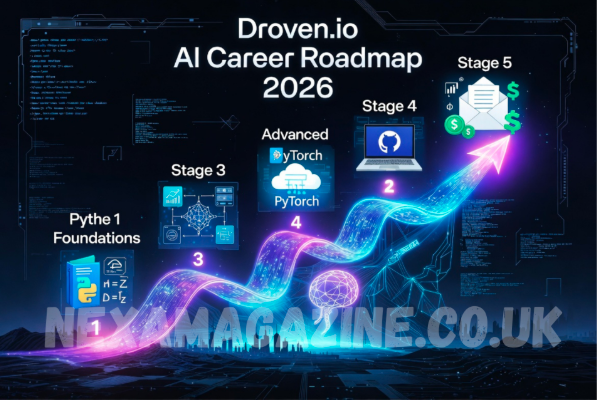
The Droven.io AI Career Roadmap is gaining attention in 2026 as more students, developers, and professionals search for practical ways to build future-proof careers in artificial intelligence. With AI rapidly transforming industries, many learners now want a clear roadmap that explains what skills to learn, which tools matter most, and how to become job-ready in the modern AI landscape.
This guide explores the Droven.io AI Career Roadmap step by step, including beginner skills, machine learning foundations, generative AI trends, portfolio building, and career opportunities in 2026.
The Droven.io AI career roadmap stands out as one of the clearest, most actionable guides for anyone serious about entering or advancing in artificial intelligence. It cuts through the overload of online courses and vague advice by offering a structured, stage-by-stage progression based on real industry needs. Whether you’re a complete beginner, a career switcher, or a developer looking to specialize, this roadmap helps you build relevant skills, create tangible projects, and position yourself for roles that companies actively hire for today.
Droven.io itself functions as a technology knowledge platform focused on AI, automation, cloud computing, cybersecurity, and emerging tech trends. Its career content draws from job market data, practical learning paths, and insights into what employers value in 2026.
Why AI Careers Are Growing Rapidly in 2026
The demand for AI professionals continues increasing because businesses are adopting machine learning, automation, generative AI, and cloud-based intelligent systems at a much faster pace. Companies now need developers, analysts, and AI specialists who can build practical solutions using modern AI tools and workflows.
The demand for AI professionals continues increasing because businesses are adopting machine learning, automation, generative AI, and cloud-based intelligent systems at a much faster pace. Companies now need developers, analysts, and AI specialists who can build practical solutions using modern AI tools and workflows.
The Future of AI Careers Beyond 2026
Future AI careers are expected to focus more on automation systems, AI agents, responsible AI development, cloud deployment, and human-AI collaboration. Professionals who combine technical skills with adaptability and problem-solving abilities may have stronger long-term career opportunities.
Essential AI Skills to Learn in 2026
Modern AI careers now require a combination of programming, machine learning, automation, and cloud-based skills. In 2026, some of the most valuable AI skills include Python, SQL, TensorFlow, PyTorch, GitHub, cloud platforms, prompt engineering, vector databases, and AI workflow automation. These tools help learners build practical AI projects and stay competitive in the rapidly evolving technology industry.
Quick Facts: Droven.io AI Career Roadmap
| Aspect | Details |
| Primary Focus | Structured AI skill-building from beginner to job-ready |
| Typical Timeline | 6–18 months (depending on prior experience and dedication) |
| Core Languages/Tools | Python, TensorFlow, PyTorch, Scikit-learn, Pandas, NumPy, SQL, Cloud (AWS/Azure/GCP) |
| Key Outcome | Portfolio of real projects + readiness for roles like ML Engineer, Data Scientist, AI Specialist |
| Target Audience | Students, career changers, developers entering AI |
| Platform Source | Droven.io editorial hub on AI and future of work |
Why the Droven.io AI Career Roadmap Matters in 2026
AI job demand continues to surge across industries. Companies need professionals who can build, deploy, and maintain intelligent systems — not just those who understand theory. The Droven.io roadmap addresses this by emphasizing practical, job-aligned learning over generic advice.
Read More : What Is Droven.io?
It aligns with how people actually search for career guidance: what to learn first, which tools matter, how to gain hands-on experience, and which specializations offer the best opportunities. Following it reduces wasted time on irrelevant topics and helps you stay current with fast-moving developments like generative AI, large language models, and AI agents.
Stage 1: Foundation – Build Strong Basics (1–3 Months)
Every solid AI career starts here. Focus on:
- Programming: Master Python fundamentals, including data types, loops, functions, and object-oriented programming.
- Mathematics: Linear algebra, probability, statistics, and calculus basics. These power model training and evaluation.
- Data Handling: Learn data structures, basic SQL, and introductory data analysis with Pandas and NumPy.
- AI Concepts: Understand the difference between traditional programming, automation, machine learning, and deep learning.
Practical Tips: Use free resources like official Python documentation, Kaggle introductory notebooks, and simple coding challenges on LeetCode or HackerRank. Aim for daily practice to build logical thinking.
This stage ensures you won’t struggle later when concepts get more complex.
Stage 2: Machine Learning Fundamentals (2–4 Months)
Move into how machines actually learn:
- Supervised learning (regression, classification)
- Unsupervised learning (clustering, dimensionality reduction)
- Model training, validation, testing, and evaluation metrics
- Feature engineering and data preprocessing
Work with real datasets from Kaggle. Build simple models like house price predictors or spam classifiers. Tools: Scikit-learn for starters.
This phase bridges theory and application, teaching you to evaluate what works and why.
Stage 3: Advanced AI and Modern Technologies (3–5 Months)
Dive deeper into current frontiers:
- Deep learning and neural networks
- Large language models (LLMs) and generative AI
- Prompt engineering and AI agents
- Computer vision and natural language processing (NLP) basics
Experiment with frameworks like TensorFlow and PyTorch. Explore Hugging Face for pre-trained models. Stay updated by following research papers (via arXiv) and practical implementations.
In 2026, familiarity with generative tools and responsible AI practices sets candidates apart.
Stage 4: Tools, Frameworks, and Cloud Proficiency
Industry expects hands-on tool knowledge:
- Core libraries: Pandas, NumPy, Matplotlib/Seaborn
- ML frameworks: TensorFlow, PyTorch, Scikit-learn
- Data and deployment: SQL, Docker basics, Git
- Cloud platforms: AWS SageMaker, Google Cloud AI, Azure ML
Learn MLOps concepts for model deployment and monitoring. Cloud skills prove especially valuable for production-ready work.
Stage 5: Real-World Projects and Portfolio Building
Theory alone won’t get you hired. Build and document projects such as:
- Chatbots or sentiment analysis tools
- Recommendation engines
- Image classification models
- Predictive analytics dashboards
- Automation scripts using AI
Host everything on GitHub with clear READMEs, code explanations, and results. Contribute to open-source or participate in Kaggle competitions. A strong portfolio demonstrates problem-solving far better than certificates.
Stage 6: Specialization – Choose Your Lane
Narrow your focus based on interests and market demand:
- Machine Learning Engineer: Model deployment, scalability
- Data Scientist: Analysis, storytelling with data
- NLP Specialist: Language models, chat systems
- Computer Vision Engineer: Image/video AI
- AI Product Manager or Automation Specialist: Business applications, less coding-heavy paths
Droven.io highlights how real job postings reveal rising needs in these areas.
Stage 7: Job Preparation and Career Launch
- Tailor your resume to highlight projects and quantifiable impact
- Practice technical interviews (LeetCode, system design)
- Prepare behavioral questions and portfolio walkthroughs
- Network on LinkedIn, attend AI meetups, or join communities like Kaggle forums
- Consider certifications (Google Professional ML Engineer, AWS Certified AI Practitioner)
Apply to entry-level roles, internships, or freelance gigs. Many transition successfully within 9–18 months of consistent effort.
Common Challenges and How to Overcome Them
- Overwhelm from options: Stick to the roadmap stages sequentially.
- Keeping skills current: Dedicate time weekly to new papers, tools, or newsletters.
- Lack of experience: Start with personal projects or open-source contributions.
- Math anxiety: Focus on applied understanding first; deepen theory as needed.
Consistency beats intensity. Even 10–15 hours weekly compounds effectively.
Source Verification
Information in this article draws from Droven.io’s own published career guides and roadmap content, cross-referenced with LinkedIn analyses, tech career resources, and job market trend reports from 2026. Droven.io positions itself as an editorial hub rather than a formal training provider, so its value lies in practical, data-informed structuring of learning paths.
FAQ: Droven.io AI Career Roadmap
How long does the Droven.io AI career roadmap take?
Most dedicated learners complete the core path in 6–12 months, with full job readiness in 9–18 months depending on background and study time.
Do I need a degree to follow this roadmap?
No. Many successful AI professionals come from self-taught or bootcamp backgrounds. Strong projects and skills matter more than formal credentials.
Is coding mandatory?
Yes for technical roles. Python is the primary language. Non-coding paths exist in AI ethics, product management, or operations, but technical foundations help everywhere.
What salary can I expect after completing the roadmap?
Entry-level AI/ML roles in 2026 often start around $100K–$150K+ in competitive markets (especially US), with experienced specialists earning significantly more.
Can beginners with no tech background succeed?
Absolutely. Start with foundations and progress steadily. Many resources assume zero prior knowledge.
Is the roadmap only for software engineers?
No. It supports various paths, including data-focused, automation, and business-oriented AI roles.
Conclusion
The Droven.io AI career roadmap delivers a no-fluff, results-oriented framework for navigating one of the most dynamic fields in 2026. By following its stages — foundations, core ML, advanced topics, tools, projects, specialization, and job prep — you gain both competence and confidence.
AI careers reward continuous learners who combine technical ability with practical application. Start today with the basics, build consistently, and document your journey. The opportunities are real for those who put in the work. Your future in AI begins with the first committed step.
Overall, the Droven.io AI Career Roadmap provides a structured way for learners to understand modern AI careers without feeling overwhelmed. As artificial intelligence continues reshaping industries in 2026, clear learning pathways and practical project-building strategies are becoming more important than ever.
-
Example:
